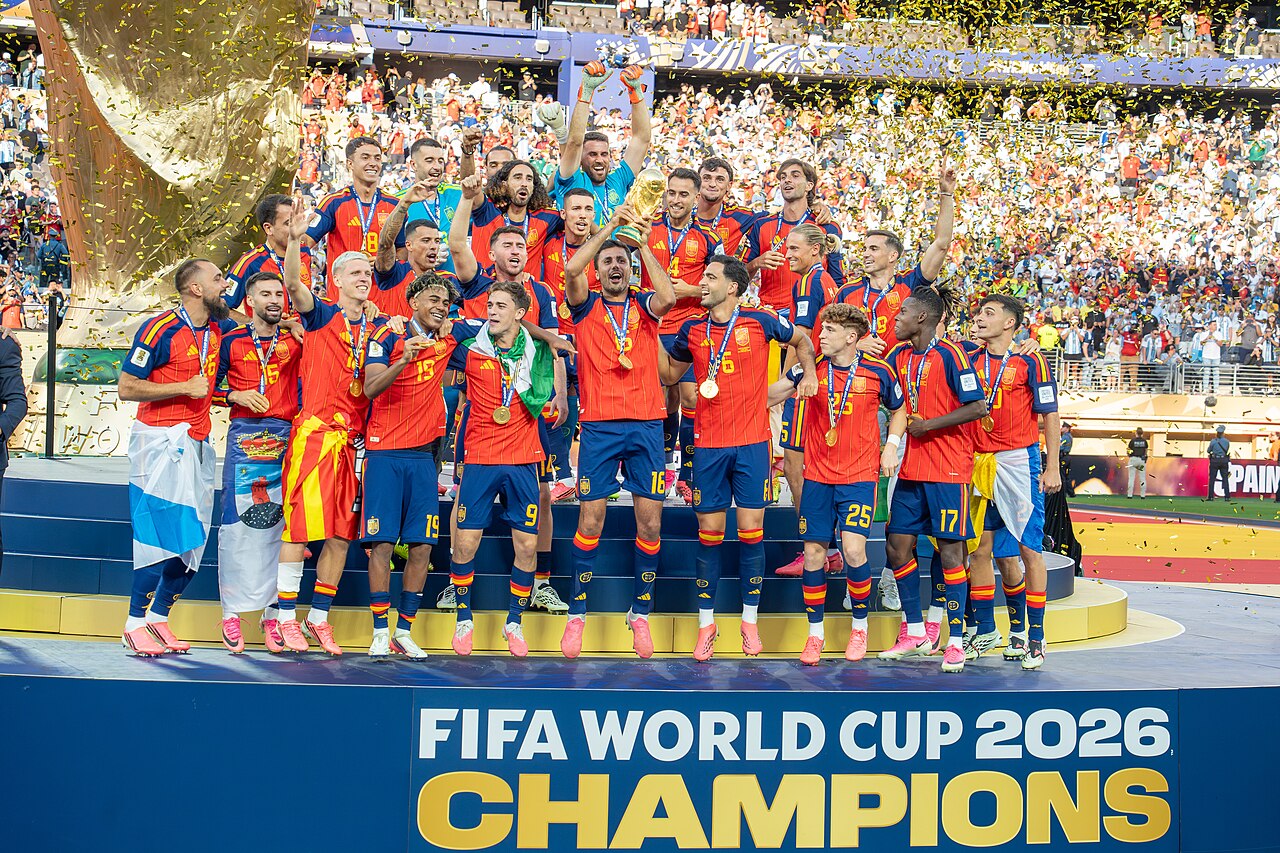
Spain are world champions, and it took them until extra time to do it. One hundred and four matches, thirty-nine days, and the whole thing came down to a final that refused to end when it was supposed to.
And after ninety-seven of us spent five weeks playing with the app, Fussspool 2026 has a champion too.
Kevin Farrugia wins it
843.88 points. Eight and a bit clear of Liam Grech. Congratulations, Kevin — and a genuinely well-earned one, because holding a lead in this pool has been about as easy as holding a lead against Spain.
Final standings
- 1Kevin Farrugia843.88
- 2Liam Grech835.18
- 3Michael Probert825.28
- 4Russell Camilleri822.94
- 5Daniel Sammut820.22
Completed matches only (confirmed final scores).
Look at that top five against where we stood at the quarterfinal break, though, because it tells you how violent the closing stages were. Michael Probert and Russell Camilleri finished third and fourth — neither of them was in the top five four matches ago. Nathan Heep and Andrew Arrigo were third and fifth and both dropped out. Only Kevin and Daniel Sammut were still standing where they’d been.
Here is the cruellest number of the lot. Over the semifinals, the third-place playoff and the final, Kevin scored 44.66 points. Liam Grech scored 49.22 — more than the champion, more than anyone near the top — and it still wasn’t enough. He arrived four matches too late.
How the title was actually won: by not letting go
Five different players led this pool across the first six rounds. Mark Camilleri, Niki Borg, Nathan Heep, Daniel Sammut, then Kevin. Nobody had managed to hold the top spot through more than two rounds all tournament.
Kevin took it after the quarterfinals and then held it after the semifinals, after the third-place playoff, and after the final. Four consecutive rounds at number one, in a tournament that had changed leader at almost every opportunity. That is the entire story of this championship: the man who took the lead last, and then simply refused to be overtaken.
The Race — leader after every round
- Matchday 1Mark Camilleri
- Matchday 2Niki Borg
- Matchday 3Nathan Heep
- Round of 32Nathan Heep
- Round of 16Daniel Sammut
- QuarterfinalsKevin Farrugia
- SemifinalsKevin Farrugia
- Match for third placeKevin Farrugia
- FinalKevin Farrugia
Gold marks a new leader; plain text means the same player held top spot.
Liam Grech’s tournament deserves its own paragraph. Ninety-fifth of ninety-seven after the group stage. Second at the end. He was fourth at the quarterfinal break and kept climbing right through to the last whistle. If this pool gave out a comeback award, there would be no debate and no vote.
The knockouts ate the favourites alive
Something happened in those last four matches that reshaped the entire tournament’s numbers, and it explains every one of those wild swings in the standings.
Across the first 100 matches, underdogs won 8% of the time. Across all 104, they won 11%. That jump — three percentage points, on a base of 104 — means the great majority of the closing matches went to the team nobody was supposed to back. Not one of them was drawn inside ninety minutes. The pool’s collective pick was wrong in three of the final four.
Result split — predicted vs actual
The knock-on effect shows up in the accuracy numbers. Underdog picks were landing at a miserable 13% at the quarterfinal break. By the end they were at 19%. Every brave coupon submitted in the closing rounds got paid, and the people who submitted them are the reason the top five looks nothing like it did a week ago.
Accuracy by pick type
Best: Liam Grech (71%)
Worst: Dave Evans (35%)
Pool average: 58%
Liam Grech finishes as the most accurate reader of this tournament — 71% of results called correctly against a pool average of 58%. Dave Evans finishes on 35%, and having held that position from the quarterfinals to the final, he has at least been magnificently consistent about it.
We finally beat the robot
At the quarterfinal break we ran a slightly humiliating experiment: a hypothetical player who submits “favourite wins 2–1” on every single match, with no thought whatsoever, would have been sitting 15th of 97. Eighty-two of us were losing to a robot with one idea.
Four matches later, that robot has slipped to 19th. The Hive Mind — the theoretical player who always submits the pool’s most popular pick — has fallen from 22nd to 26th. When the underdogs started winning, the mindless strategies had no answer, and actual human judgement finally pulled ahead.
Same result, every game
Pick Favourite 2–1 every game and you would finish #19 of 97 (783.64 pts).
Draws hit 23% of games but were priced at 23%.
10 of the top 10 climbed on 3+ big-odds hits — pool average: 5.2.
The favourite trap: the more favourites you backed, the fewer points you scored.
The best evidence sits in the strategy table itself. “Underdog 1–0 every game” — the worst idea in the entire experiment, dead last for the whole tournament — picked up more points across the final four matches than any other fixed strategy on the board. It gained over sixty. The favourite-based strategies gained roughly half that.
Which is a very long way of saying: the closing stages belonged to whoever was brave.
Two matches nobody in this pool will forget
The last four matches gave us the highest-scoring game of the entire World Cup. France 4–6 England. Ten goals. It knocked Germany’s 7–1 demolition of Curaçao off a perch it had held since the group stage, and it did it in a knockout match, which is not how knockout matches are supposed to work.
Those closing rounds also produced the single most divided match in Fussspool history: England v Argentina, with 32 of us backing the home side and 31 backing the away side. A ninety-seven-strong pool, split almost exactly in half. Whatever you thought was going to happen in that game, roughly half the room thought the opposite.
Those ten goals dragged the tournament scoring average up from 2.92 to 2.96 goals a game in the space of four matches. The closing stages ran at roughly four goals a game — comfortably the most open football of the whole World Cup, at precisely the point when everyone expected it to tighten up.
Where the title was won: the boring column
We said this at the quarterfinals and the final four matches only made it more true. Over/under is the biggest single source of points in this competition — 25,060 of them, 37% of everything scored all tournament. The exact scoreline everybody agonises over accounts for 4%.
Where the points came from
And here, finally, is the cleanest explanation of why the top ten are the top ten. It isn’t flair. It’s seven more over/under hits and ten more correct results than the average player, accumulated one coupon at a time over 104 matches. That’s a 73-point advantage built almost entirely out of the least glamorous part of the form.
Where points are won — top 10 vs pool average
Over / under
Correct results
It stayed an over tournament to the last kick. A player who simply ticked OVER every single time, without a moment’s thought, would have finished on 290 over/under points against a pool average of 258. Thirty-two free points for doing less thinking. Store that one away for 2028.
Over/under — is it a coin flip?
What actually happened
Dashed line = 50% — a coin flip.
What happens when players pick under
stayed under — won lost by 1 goal lost by 2+
The tournament in full
One hundred and four matches. Ninety-seven of us. Here is what we collectively got right and wrong.
FIFA World Cup 2026
We backed the favourite three times in every four. The favourite delivered roughly two times in three. That gap is the tax this pool paid all summer, and it never once closed.
Daphne Hili ends the tournament as the exact-score champion on 17 — and she added one more in the closing stages, when the scorelines were at their least predictable. Somewhere in this pool there is still one player who never called a single scoreline correctly across 104 matches. We’re still not naming them. They still know.
Thirty-three matches were near-unanimous. In twenty-seven of them we all backed the favourite, in six we all called a draw, and in exactly zero did this pool collectively fancy an underdog. Given how the last week went, that might be the most instructive number of the entire competition.
Monster favourites
23 matches where the shortest price was 1.30 or less
The giants never lose… they draw.
The best single call of the World Cup
It survived the whole tournament. Ninety-five of us looked at Ecuador v Curaçao and did the sensible thing. Two didn’t, took 0–0 at a price of 9.99, and banked 27.98 points from one match. Nothing in the semifinals, the third-place playoff or the final came close to beating it.
Biggest single-match jackpot
And we remained gloriously optimistic to the end. Fourteen of us predicted a 0–5 at some point. Seven went 7–0. Across 104 matches, none of it happened.
Most-picked scorelines that never happened
See you at Euro 2028
That’s it. Spain are champions, Kevin Farrugia is our champion, and ninety-seven coupons go quiet for a while.
Thank you to every single one of you who submitted a prediction, argued about a scoreline, backed a 9.99 shot on a Tuesday night, or refused to change a pick out of pure stubbornness and was proved right. A pool of ninety-seven is what makes any of these numbers interesting — with ten players, none of this exists.
Take what you learned. Back a few more draws. Tick OVER more often than feels comfortable. And remember that the player who wins is rarely the one who calls the miracle — it’s the one who stops giving points away.
Euro 2028. Coupons open closer to the time. See you there.